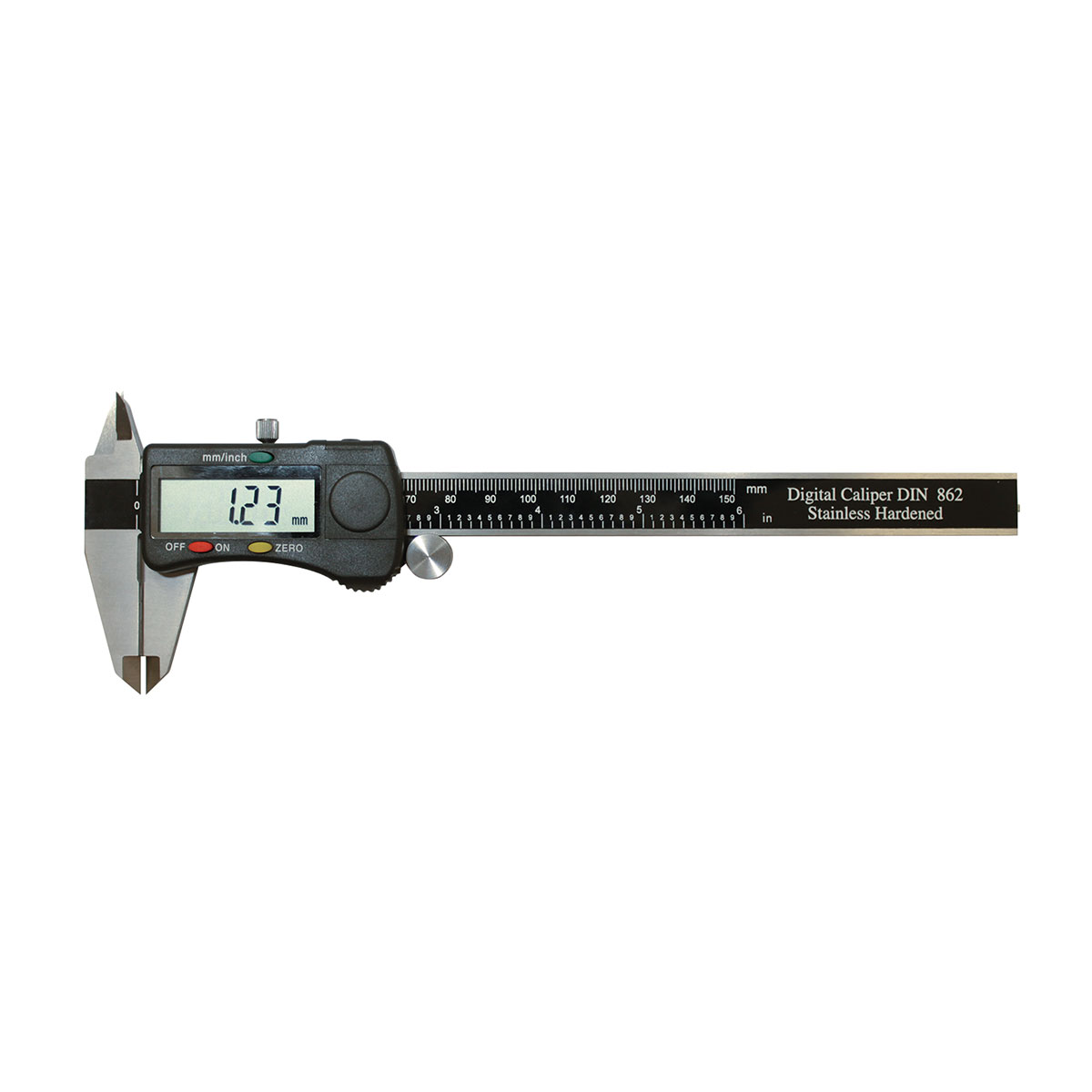
Bernstein digital calliper gauge with data output
– according to DIN862
– measuring range 150 mm (6 inch), beak down 40 mm, up 10 mm
– tolerance 0.02 mm
– 3-digit LCD display, large display
– switchable metric / inch
– with depth gauge and locking screw
– plastic housing and steel ruler
– delivered in a plastic protective box and with battery
– length 250 mm
– weight 200 g
Scope of application
The vernier caliper, also known as a slide caliper, can be used to measure internal dimensions, external dimensions and depths. Testing and measuring equipment are among the most important tools and belong on every workbench or in every toolbox. They can be used to determine diameters, measure core holes in diameter and depth, or the distance between two threads, i.e. the pitch of the thread. To ensure that you get the correct measurement, you should be aware of the following errors when measuring. Hold the caliper and the part to be measured still and straight, and do not tilt them. Pay attention to your measuring pressure; too much or too little measuring force will affect the measurement result. Ideally, you should have a constant reference temperature of 20 degrees Celsius; strong temperature fluctuations will change the measurement results. Please check your calliper regularly for damage, quirks, notches and remove dirt immediately.
Technical product description
INCLUDING BATTERY. Please note the following information on our products: The symbol of the crossed-out wheelie bin means that the battery must not be disposed of in household waste. You can return old batteries to us free of charge. The symbols on the batteries have the following meaning: Pb = battery contains more than 0.004 percent by mass of lead / Cd = battery contains more than 0.002 percent by mass of cadmium / Hg = battery contains more than 0.0005 percent by mass of mercury.
General information
There are digital calipers (with LCD display) and analog calipers (with a vernier scale). The advantages of digital calipers are that they provide a convenient and quick reading on the display in metric and inch sizes. The disadvantages of digital calipers are the power supply (battery dead), they are not dust-resistant, waterproof or oil-resistant. The advantages of analog calipers, on the other hand, are their durability and longevity. However, it takes a little practice to read the vernier scale. How to read the vernier scale correctly: the measuring accuracy is exactly 1/10 mm, with 9 mm divided into 10 equal parts, one part corresponding to 9/10 mm. The analog caliper has two scales: one on the fixed part and one on the movable part. The fixed scale is in mm and the movable scale is in 0.1 mm. Look along the movable scale for the point where it lines up with a point on the fixed scale. If the scale is in mm, then the zero on the movable scale is in line with the top scale. If, for example, you move the lower scale to the middle of two lines on the upper scale, the result is very likely to be 5. If it is between 10 and 11 mm, then our measurement result is 10.5 mm.